
Looking Beneath the Surface
A guide to a neurological, movement-based intervention approach.
Primitive Reflexes - The Foundation of our Nervous System
When we look at brain development, it develops in three stages. It’s important we support all three areas of development for optimal results.
Stage 1 - It develops front-back: connects the brainstem to the cerebellum
Protection and survival; self-regulation; flexibility
Unconsciousness development
Automatic reflexes - primitive reflexes
Stage 2 - Then, from the bottom-up (vertical): connects cerebral cortex and the brainstem
Experience and emotional response
Consciousness and subconsciousness
Continued growth through primitive reflex integration
Stage 3 - Finally, it develops right-left (horizontal): connecting the right and left hemispheres
Learning and development; cognition; cause & effect
Consciousness
Growth & balance through brain hemispheric integration
So What are Primitive Reflexes and Why are They Relevant?
Primitive reflexes are involuntary and automatic movements that originate in the brainstem. They present after birth and are imperative for our survival. The majority of primitive reflexes are integrated by 12 months and replaced with postural reflexes that allow voluntary motor activity. They are the foundation of the nervous system, which means they need to integrate in order to optimise higher-level cognitive functions such as learning, memory, organization, etc.
There are multiple types of reflexes:
Tonic neck reflexes are related to head movement and vestibular system
Suck, hand, and foot reflexes important for protection & survival
Moro protects us from disruption of body balance; FPR protects us from sensory information
Unfortunately although the research on retained primitive reflexes and the benefits of integrating them has been around for many years now, it has not been a great focus of mainstream health care unless serious damage or trauma has occurred, which is often not the case. Primitive reflexes can be retained for a wide variety of reasons including:
Stress to the mother and/or baby during pregnancy
Lack of movement in utero
Premature birth or traumatic birth e.g. prolonged labor, breech position, forceps and suction, c-section birth.
Restricted body movements, such as the infant spending extended time in car seats, carriers, walkers or jumpers
Missed or late milestones including sitting, crawling, walking etc.
Meeting milestones earlier than the typical range
Illness, injury, trauma, chronic stress, exposure to toxins
Other developmental delays
What Happens When They Remain Unintegrated Past Infancy?
Body parts may be unable to move independently (poor volitional control of movement)
Will trigger the “fight, flight, freeze” response causing chronic stress, inflammation and overload
Increased amount of effort to perform daily tasks
Working memory is not able to retain information properly; commonly see kids showing knowledge that disappears the next day
It can present difficulties with higher cognitive development in the prefrontal cortex resulting in difficulty learning, reading, memory, organization, attention, behavior, etc.
Please see our handout discussing the full symptoms of the 9 primary primitive reflexes that commonly impact development and a child or adult's ability to function to their full potential.
It can cause challenges with balancing the right and left hemisphere of the brain.
Brain Development - the link between hemispheric imbalances and retained primitive reflexes.
Our brains have 2 hemispheres, and they generally coordinate tasks and communicate efficiently. However, each hemisphere has its own strengths and weaknesses, and they tend to go through phases of development, where one hemisphere seems to be working harder than the other. This flip-flop between hemispheres continues through childhood until adulthood, and it gets less and less obvious with age. However in the early years it is quite clear the differences between right and left hemispheres, and when they are developing.
For the first 3 years of life (approximately), the right hemisphere is the ‘dominant’ hemisphere. It is busy making loads of connections, and strengthening those connections with their environment experience.
In terms of what the right brain does, it’s interesting to know that the right brain can do what the left brain can do, but the left brain can’t do what the right can do - this is often why we start to see issues beyond 3yo when the left brain is supposed to kick in, and deficiencies in the right brain become more apparent.
The biggest driver of brain development is sensory input, in the form of movement. A healthy sensory system is essential to healthy brain development, in particular sensory input that is equal on both sides of the body. And this is why I recommend taking your kids to a chiropractor, osteopath, craniosacral therapist or other bodyworker!
Gross motor milestones MATTER for the rest of the brain.
Movement drives a lot of the brain’s power, so even once your brain is ‘fully developed’, this is why exercise makes you feel SO GOOD! It’s like the power source to your brain. (And this is why kids should not be expected to sit still all day while learning, it’s the exact opposite of what our nervous systems need to experience learning and joy).
The right brain develops in the womb, and is more electrically active (than the left) in the first
3 years. Both hemispheres are active, but the right is more. It is very sensitive to the environment around them, and enables babies to get a big picture of what is going on, early on in life.
An important factor for brain development while in the womb is the level of stress the mother is under. Now I don't just mean emotional stress - I mean physical stress - detox / inflammation / diet / exposures to endocrine disruptors etc. This can actually set the stage for your child's muscle tone and movement in the early years.
Right brain functions
The right brain is SENSORY driven. It takes everything in. Think of a baby that doesn’t have much motor movement yet, but they sit back and take everything in. This hemisphere is working hard for the first 3 years of life (which is why many people see a shift in their toddler when they hit three - because the left hemisphere begins to kick in!).
Main functions:
Its primary job is to help you form relationships. It’s all about connection (and this is why it works alongside the vagus nerve). When a baby is smiling at you, they see the smile is reinforced with you smiling and being happy - this strengthens the social connection and vagus / safety - this gets reinforced into emotions and connection.
It scans the environment, looking for novel or dangerous things to withdraw from and keep you safe. It seeks novel things and analyses them for their threat level. It inhibits behaviour that may be dangerous.
It is involved in non-verbal communication and emotional IQ.
It controls gross motor skills, posture and the vestibular center.
It is linked to subconscious memories. This is why many of our patterns and learned behaviours are learnt in those early years - where the right brain is dominant and taking it all in.
Suppression of the immune system - prevents autoimmunity.
Other things it is involved with include -
Interpreting auditory input
Understanding abstract concepts
Likes novelty and newness
Sense of taste and smell
Spatial awareness
Digestion
Self-awareness
Ethics, Moral compass
Big issues
Others feelings, Emotional intelligence
Unconscious actions
Interpreting information - comprehension
When the right 'goes wrong'
Symptoms include:
Don’t feel their bodies well
Poor postural muscle tone
Might have an odd gait
Poor coordination, balance, and rhythm - delayed gross motor
Socially awkward, hard to make friends
Picky eaters
Reduced smell or taste
Struggle with non-verbal communication
Struggle to learn verbal communication in the sense they might be able to read but possibly not understand what they’re reading
Poor attention span, impulsive, anxious, compulsive
Sensitive to their environment, foods, allergies, asthma etc
The right side usually suppresses the immune system so when delayed the immune system becomes autoimmunity, food sensitivities
Rapid heartbeat
Poor digestion
Non-verbal learning disorder
Pervasive developmental disorder
Developmental coordination disorder
Conduct disorder
Common diagnoses:
ADD
ADHD
Autism
Tourette
OCD
ODD
Left Brain Functions:
Here’s where it gets tricky, you might have a child with right hemisphere delay/deficiency, who actually presents with left hemisphere overactivity. And? You can have both. So while we will cover what a child with right brain deficiency can present with, I also wanted to touch on the left hemisphere too. This can be like a seesaw - if you have a right hemisphere that is “low”, the left can take over, and you can see these things earlier due to relativity e.g. large tonsils and adenoids.
The functions of the left brain:
More subtle than right brain deficiency
Shy and withdrawn
Not motivated to do typical kid things
Prefer to hang around the house than go play with friends
Sullen and sad - depression is common
Slow to start speaking
Not great verbally and not speaking a lot
Poor language - struggles with reading and spelling
Struggles with processing words and sounds
Struggles with many subjects such as maths
Poor fine motor and bad handwriting
Concerned with how they look and dress
Ability to read people and situations
Good athletes
Lead well outside the classroom
Prone to chronic infections such as colds, ear infections
Common Diagnoses:
Learning disability
Language disorder
Reading disorder
Acalculia
Selective mutism
Dyslexia
Processing disorder
Central auditory processing disorder
Dyspraxia
Dysgraphia
Traditional Medical Model Or Neurological Approach?
When your child is struggling and you seek professional help, the traditional medical
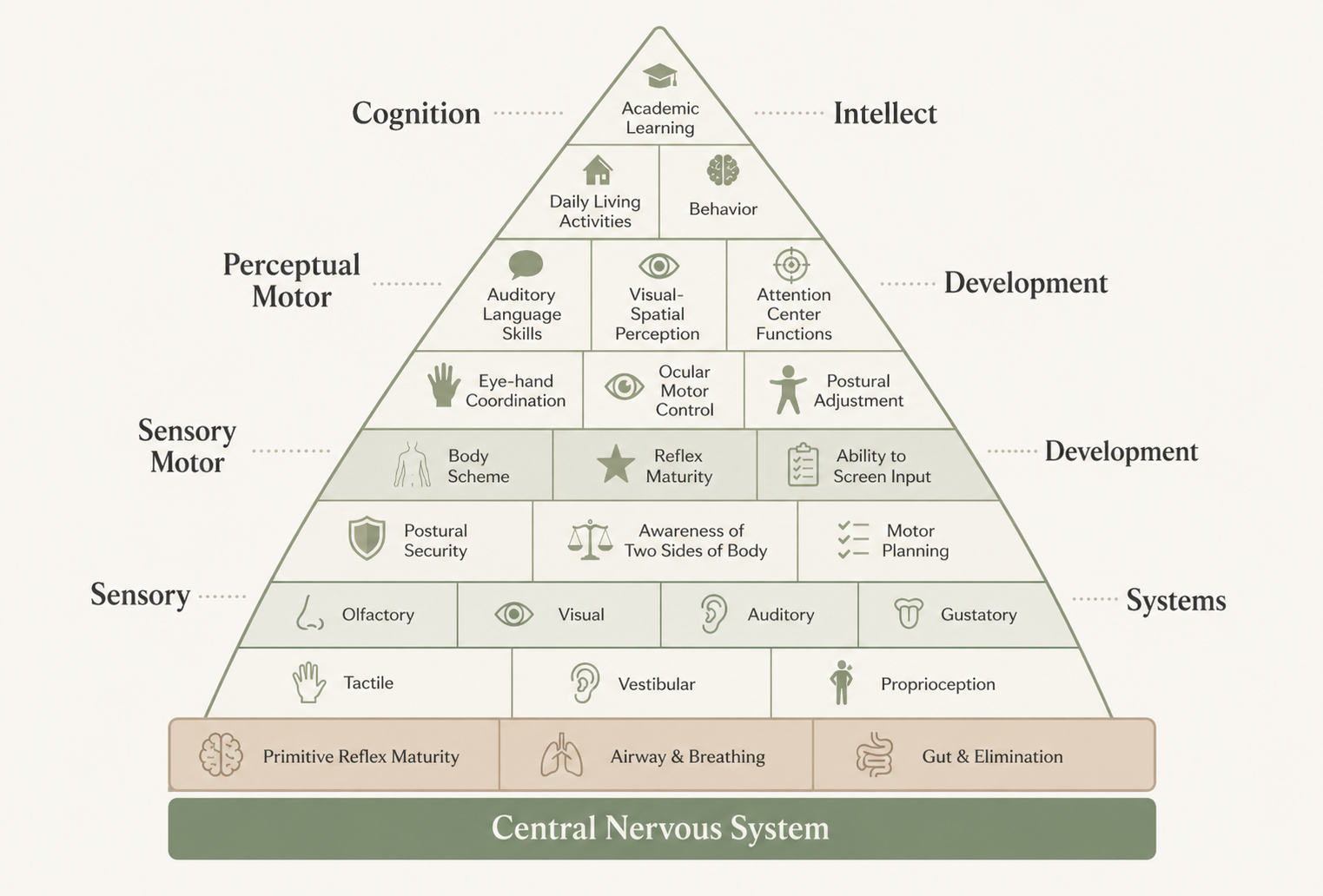
model is the current go-to. Commonly the traditional models of intervention often overlook the cause of a child’s symptoms and instead work to treat or manage the symptoms themselves. Often, the therapies and treatments start in the middle or upper end of the pyramid of development (depicted below). However, if any of the steps lower in the pyramid are weak or have not developed efficiently, it can cause difficulties and challenges in the higher levels of learning. This is what we call “gaps” in the foundation of their nervous system, creating a disconnection between their brain growth & body growth.
Our holistic approach starts treatment at the foundation, filling in any missing gaps, integrating movement & sensory systems, then developing skills and executive function.
So What Do We Do If There Are Hemispheric Imbalances Or Retained Primitive Reflexes?
We use movement to create a strong neurological foundation by “filling the gaps” of development. Our home program guides you through primitive reflex integration as well as specific stimulation to balance the brain hemispheres, creating optimal function in learning, behaviours and sensory systems.
Moving in a purposeful way to connect right and left hemispheres, and balance the brain can be done easily from the comfort of your home. Building the neurological foundation that all children experience during infancy helps to create strong neural connections that enable skills like attention, behavior, coordination, visual-motor control, & academics to come much easier for the child. We start with specific movements for reflex integration with sensory stimulation, then add in purposeful movements that are fun and playful — perfect for in between school breaks, after school, or as a wake-up method in the morning. With guidance from your practitioners, you can help create real, lasting change in your child’s life!
When we’re working with the brain, it takes small amounts of practice everyday to see lasting effects. The exercises in our home programs can be completed in approximately 20 minutes, 5-7 days per week for best results. When done frequently, this reduces the length of time it takes to see progress.
